Stretching as an Exercise Routine

stretchingBelow is part one of a three part series on exercise to control chronic pain. Part one is on stretching, and the next two parts will be on developing an exercise program and the importance of conditioning.

As part of any good exercise program for pain and general conditioning, stretching is an essential component. The other parts are strengthening and aerobic conditioning. Stretching maintains range of motion and proper muscle and tendon length. Poor range of motion with tight tendons, ligaments and muscles often lead to pain.

Stretching can be done as an independent component of an overall program or integrated into an overall program. There are very few restrictions on stretching, but find a system that works for you. A lot of people with back pain have trouble at night and first thing in the morning. Stretching for several minutes before bed and first thing in the morning is often helpful. If you’d like to integrate a stretching program with strengthening, consider yoga and Pilates routines since these will include good stretching routines.

Stretching and Your Needs

Depending on your needs, stretching can be done for any area of the body. If you are a book person, there is one titled “Stretching” by Robert Anderson that covers any region of the body. Nowadays, everyone seems to have a smart phone and with a simple search of the App Store, multiple apps can be found on proper stretching techniques. You can also search the web for information. The Princeton University physical therapy site has good information for neck and low back regions.

For those who have low back pain, a thorough stretching program can significantly help control pain. Often a large portion of symptoms are related to tight muscles in the core and lower half of the body. Stretching needs to include all areas of the low back and legs. In general, it will include flexor muscles as well as extensor. Most people concentrate on increasing flexion of the body to loosen the low back, but ignoring the extensor muscles may leave one prone to hip and pelvic pain.

Stretching in low back pain patients can often open up the neuroforamina where the nerve roots exit the spine and relieve pinched nerves. Just bending forward and touching the toes or the floor while standing does a good job to stretch the low back and legs. 10-30 seconds of a slow stretch may reduce muscle spasms and pain, allowing one to continue activity for a prolonged period. With a diagnosis of lumbar spinal stenosis, simple forward stretches may reduce pinching of the nerves and allow ongoing activity such as walking with minimal pain symptoms.

Stretching Devices

Stretching can also be done in more formal ways using techniques such as traction, massage and adjustments or manipulation of the body. Traction requires a device to appropriately stretch the neck or low back regions. Neck traction devices that are good include those manufactured by Saunders or Pronex and usually should be prescribed by a healthcare provider  Lumbar traction can be done with fancy traction devices often used by chiropractors or by using an inversion table. The inversion tables are generally safe as long as they are well built and one is securely restrained at the ankles. Deep tissue massage and chiropractic or osteopathic type adjustments can also be part of a stretching routine.

Stretching on long term basis should ideally be part of an individual’s program that is able to be performed on your own at home. Sometimes equipment is beneficial, but for most people just a set of exercises should be sufficient. Physical therapy may help if you have not been able to move well and are afraid of more pain if you try to move. Stretching is not hard if you are self motivated and willing to learn on your own. If you have pain or are afraid of injury, get help, whether it is from a healthcare professional, physical therapist, or other person.
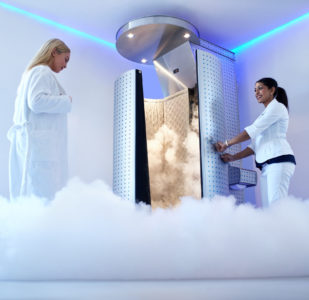

Is Cryotherapy Worth The Trouble?

cryotFor the stars, major sports athletes and the exercise enthusiasts, one of the newer trends is cryotherapy. In short, it involves immersing oneself in extreme cold after an intense workout. The intense variety is a liquid nitrogen vapor chamber with the head outside and the body exposed to minus 292 degrees Fahrenheit for at the most three minutes. It is supposed to prevent inflammation and promote faster recovery from intense physical activity. The main focus of treatment is for athletes, but there have been claims that it helps a number of conditions like Multiple Sclerosis, Rheumatoid Arthritis, migraines, fibromyalgia, Alzheimer’s, chronic pain and anxiety.

Cooling, ice and cryotherapy work on the premise of decreasing inflammation throughout the body. Cryotherapy is an inexpensive treatment, probably costing about $15 per session, but that can add up quickly if you do it after every workout. During a workout, the body produces increased waste products of metabolism. In general, these do not necessarily cause pain and inflammation. In fact, after a workout, one may want to flush the waste products out of the body versus rapidly cooling down the body and decreasing the body’s elimination of any of these waste products. Furthermore there is absolutely no scientific evidence to prove that cryotherapy works or helps athletes or any of the above illnesses.

Simpler is Often Better

Local inflammation can be helped with icing in the initial phase during the first 24 to 48 hours. An ice pack is an inexpensive and simple way to decrease blood flow to an area and diminish inflammation. After the first 48 hours, heat is helpful to increase blood flow and get rid of any inflammatory products left over. Throughout that time, adequate hydration of the body is needed so the natural processes can eliminate waste products versus accumulating locally and causing pain.

Fads for health often are merely just hype. Many are costly, and most have little to no scientific basis to be helpful. Whole body cooling for instance, if not done extremely carefully, can easily stress the heart and cause frostbite burns. Further, it may cause vessel constriction and prevent the body from eliminating waste products produced with exercise. Most fads are often an exaggeration of practical strategies for a problem. Changing hydration with drinking a sport’s drink to getting intravenous hydration with vitamins after athletic events, or slowing down and breathing deeply after a race compared to wearing an oxygen mask and breathing pure oxygen gas are both examples of this. There really is no science behind any of these trends and mostly are targeted at high profile individuals who are then emulated by others.

As far as cryotherapy goes, it surfaced a couple of years ago and the science is still not present. In 2016, the Food and Drug Administration actually posted a statement saying there is no evidence of any of the claims of helping athletes or curing diseases. Maybe the best advice the old KISS principle, keep it simple stupid, and try the ice pack when needed.

How Much Sleep Is Chronic Pain Costing You?

sleep chronic painIn order to fall asleep, we usually need to have a calm physical and mental presence, and that can be very difficult to achieve if you have chronic pain. Chronic pain conditions can make it difficult for patients to not only fall asleep, but stay asleep. In order to get a better understanding of how chronic pain affects the amount of sleep we receive, we turn to two recent studies on the matter.

Chronic Pain and Sleep Deprivation

For the first study, the National Sleep Foundation wanted to see how chronic pain impacted sleep duration and sleep quality. After looking at the data, researchers found that individuals with chronic pain had an average of a 42-minute sleep deficit between the amount of sleep they need and the amount they are getting.

“The relationship between pain and sleep is complex, as the consequences of sleep problems can affect perception to pain and, in turn, pain can interfere with sleep quality,” said Professor Robert Landewe, Chairperson of the Scientific Programme Committee, EULAR. “This is why these studies are important as they help elucidate the role of sleep in chronic pain and highlight it as a potentially important modifiable risk factor for alleviating the distress in these patients.”

Researchers also wanted to see if sleep problems could predict the eventual onset of chronic pain. The four sleep factors they analyzed were:

  • Initiating Sleep
  • Maintaining Sleep
  • Early Morning Waking
  • Non-Restorative Sleep

According to researchers, all factors except early morning waking predicted the onset of chronic widespread pain at 18 years.

“Our results demonstrate that sleep problems are an important predictor for chronic pain prognosis and highlight the importance of the assessment of sleep quality in the clinics,” said Katarina Aili, PhD, of the Spenshult Research and Development Center in Sweden.

Anxiety and Chronic Pain

In the second study, researchers explored the link between chronic pain, anxiety and the inability to achieve restful sleep. When compared with a normal population, individuals with chronic pain were much more likely to report both anxiety and severe sleep problems.

“Although the relationship between sleep and pain is complex, our results clearly indicate a strong association which needs to be explored further,” said Julia S. Malmborg, PhD student at Halmstad University. “As both problems affect the physiological and psychological well-being of sufferers we hope that these results will be used by school health professionals to promote student health.”

Getting good sleep is hard enough before chronic pain gets in the way, but if you want to give yourself the best chance to fall asleep and stay asleep, consider the following tips:

  • Avoid caffeine within three hours of going to bed.
  • Avoid working out right before bed.
  • Make the bedroom as dark as possible.
  • Turn off distractions like the television or your phone.
  • Invest in a supportive mattress and pillow.
  • Keep the bedroom temperature cool.

For more tips on maintaining healthy sleep if you have chronic pain, reach out to Dr. Cohn today.

Have Chronic Pain? There’s An App For That

Each day, millions of Americans battle a chronic pain condition or rehab a previous injury. If you’re one of them, you’ve probably done your research online and listened to your doctor’s instructions about caring for the injury. Those are great ways to manage your condition, but technology is making it easier for us to stay connected with our care plan when we’re on the go.

If you have a smartphone, you’re only a couple of clicks away from being able to access thousands of different apps that are designed to help you control and treat your pain condition. But how can you sort the good apps from the ones that aren’t worth your time?

The Best Chronic Pain Apps

To answer that question, we turn to our friends at Burning Nights CRPS. We’ve shared some of their stuff on our blog in the past, and they always share useful information for chronic pain sufferers. Their latest infographic is no different. In this infographic, they take a look at six of the most useful apps for chronic pain sufferers.

From helping to coordinate a physical therapy plan to helping you track your progress with a pain journal, the apps highlighted in this infographic can be very useful to anyone who is trying to put a chronic pain condition behind them. Give it a look, and don’t forget to check out Burning Nights CRPS for more information on all things chronic pain!

chronic pain apps

NIH Issues New Plan To Tackle Opioid Crisis

opioids pain planEarlier today, the National Institutes of Health issued its new plan for taking on the opioid crisis in America. The plan is titled Helping to End Addiction Long-term, or HEAL. The plan has two main goals:

  • Fund projects that will help develop or facilitate treatments for opioid addiction and overdose.
  • Fund projects that are meant to improve the management of pain through research into how acute pain transitions to chronic pain, as well as research nonaddictive pain treatments.

“Like most other pioneering scientific initiatives, HEAL will focus on a range of objectives, from short-term goals to research priorities that will take longer to bear fruit,” the authors wrote. “Yet, all will be aimed at the same ultimate vision: a nation of people with far less disabling pain and opioid addiction.”

Treating Addiction and Overdose

For starters, researchers want to take a closer look at how we’re currently battling addiction and overdose. Through their research, they found that there are three main drugs prescribed to help wean people off of opioids. Researchers found that most people living with opioid addiction never get started on these treatments, and of those that do, half of them relapse within a year.

“Research to reformulate these medications to improve adherence, as well as to develop new, more flexible therapies, is needed to help those who have opioid use disorder,” the authors wrote.

The NIH also wants to fund efforts to create better drugs for reversing overdoses, especially among individuals who overdose on fentanyl. The current reversal drug is naloxone, and it isn’t as effective as experts want it to be when the overdoser has other drugs or alcohol in their system.

Treating Addiction Before It Starts

The second part of the initiative focuses on coming up with better pain treatment plans and stopping pain before it become chronic. This is what we’ve been championing for on the blog for years. We need to treat addiction at the source, and the underlying reason behind addiction is unaddressed pain. We need to find better ways to treat and manage pain conditions so they don’t progress to the point where opioids are needed.

Funding for both parts of the plan will come from a $500 million grant that Congress set aside for the NIH in the 2018 budget